- Home
- Programme
- Registration
- Practical Guide
- About Neuronus
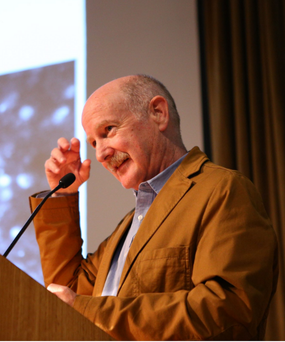
Columbia University, US
Rafael Yuste, M.D., Ph.D, is a neuroscientist that studies the cerebral cortex atColumbia University.
Yuste pioneered the development of many imaging techniques and led the researchers who proposed the US BRAIN Initiative and the “Morningside” group proposal of novel human rights (“Neurorights”) to protect brain activity and brain data. He recently spearheaded the launching of Spain Neurotech, a Spanish Brain Initiative.
Talk: ”Learning principles of neuroscience from the “vulgar” Hydra”
The small freshwater cnidarian Hydra vulgaris has one of the simplest nervous systems (1), yet exhibits relatively sophisticated behaviors (2). Due to its transparency, its complete neural (3) and muscle activity (4) can be effectively imaged. Moreover, one can completely dissociate Hydra into individual cells and image how the animal reaggregates and puts itself back together (5). Our goal is to take advantage of this preparation to "break the neural code" of Hydra: to understand the complete set of transformations from neural to muscle activity to behavior. As an example of this, we have investigated somersaulting, an acrobatic locomotion (6), finding that it is controlled by a neuropeptide, Hym-248, secreted by a specific neuronal ensemble, using integrate to threshold algorithms in a cross-inhibition circuit motif. To further understand how Hydra’s ensembles are wired, we have performed a partial ultrastructural reconstruction of the endoderm nerve net. Neurons have several different types of vesicles, including clear and dense core ones, which could support synaptic transmission. However, most vesicles are located far from other neurons. This indicates that Hydra's endodermal nerve net operates as a non-synaptic circuit, using a neuroendocrine chemical network to implement its functional operations (7). To test this, we computationally reconstruct the neuropeptide-GPCRs network in Hydra and modelled its dynamics, finding that this network has a distributed and recurrent connectivity that can sustain stable functional states (8). Our results suggest the existence in Hydra´s nervous systems of attractor neural networks implemented with chemical signaling, as opposed to synaptic wiring.
1. Yuste R. Breaking the neural code of a cnidarian: Learning principles of neuroscience from the"vulgar" Hydra. Curr Opin Neurobiol. 2024 Jun;86:102869. doi: 10.1016/j.conb.2024.102869. Epub 2024 Mar 28. PMID: 38552547.
2. Han S, Taralova E, Dupre C, Yuste R. Comprehensive machine learning analysis of Hydra
behavior reveals a stable basal behavioral repertoire. Elife. 2018;7. Epub 2018/03/29. doi: 10.7554/eLife.32605. PubMed PMID: 29589829; PMCID: PMC5922975.
3. Dupre C, Yuste R. Non-overlapping Neural Networks in Hydra vulgaris. Curr Biol. 2017. doi: 10.1016/j.cub.2017.02.049. PubMed PMID: 28366745.
4. Szymanski JR, Yuste R. Mapping the Whole-Body Muscle Activity of Hydra vulgaris. Curr Biol. 2019;29(11):1807-17 e3. doi: 10.1016/j.cub.2019.05.012. PubMed PMID: 31130460.
5. Lovas JR, Yuste R. Ensemble synchronization in the reassembly of Hydra's nervous system. Current Biology. 2021;31(17):3784-+. doi: 10.1016/j.cub.2021.06.047. PubMed PMID: WOS:000698683900007.
6. Yamamoto W, Yuste R. Peptide-driven control of somersaulting in Hydra vulgaris. Curr Biol. 2023;33(10):1893-905 e4. Epub 2023/04/12. doi: 10.1016/j.cub.2023.03.047. PubMed PMID: 37040768.
7. Zhang S, Ofer N, Dupre C, Wang X, Schalek R, Wu Y, Lin M, Roth M, Adhinarta J, Gohain A, Fan Y, Yin W, Wei D, Lichtman J, Yuste R. Ultrastructural reconstruction of the endodermal nerve net of Hydra vulgaris. Curr Biol. 2025 Nov 17;35(22):5490-5501.e3. doi: 10.1016/j.cub.2025.10.001. Epub 2025 Oct 29. PMID: 41167196.
8. De la Cruz, J., Yañez, L.-A., Teufel, F. & Yuste, R. (2026). Dense and distributed neuropeptide network in Hydra vulgaris. PLOS Comp. Biol. (in press).